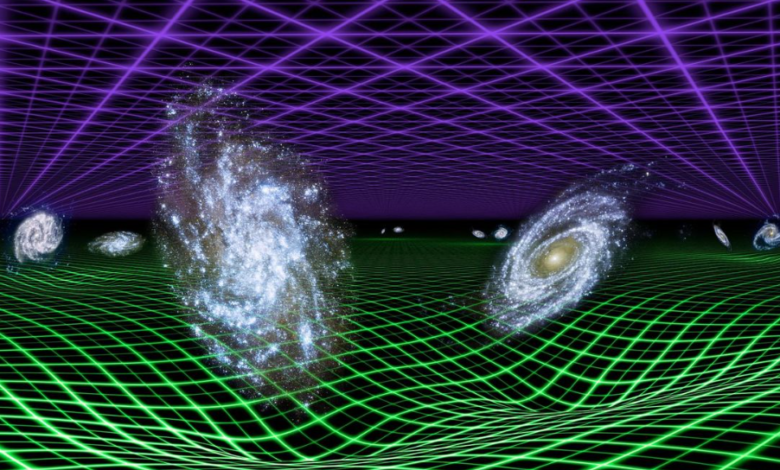
An emerging framework claims to unite quantum physics, gravity, dark matter, dark energy — and even black holes — without exotic particles. For more than a century, modern physics has rested on two towering achievements: quantum mechanics, which governs the microscopic world, and general relativity, which explains gravity and the structure of the cosmos. Each theory is extraordinarily successful in its own domain. Yet despite decades of effort, they remain fundamentally incompatible.
This incompatibility is not merely a technical problem. It has forced physicists to introduce entire unseen sectors of reality — dark matter and dark energy — which together are thought to make up about 95 percent of the universe. It has also left some of the most famous experiments in physics, such as the double-slit experiment and quantum entanglement, conceptually unresolved. And it predicts singularities inside black holes, regions where the equations of physics break down entirely.
Now, a new theoretical framework is attracting quiet but growing attention for offering a radically different approach. Rather than modifying quantum mechanics, quantizing gravity, or adding new particles, the theory starts from a simpler — and more uncomfortable — premise: The problem may not be the laws of physics themselves, but our assumption that empty space is truly empty.
The framework, known as Relativistic Coherent Vacuum Gravity Theory (rCVGT), proposes that the vacuum itself is a physical, structured medium, whose internal organization gives rise to gravity, time dilation, quantum phenomena, and the effects currently attributed to dark matter and dark energy. If the theory survives scrutiny, it could mark a turning point — not by adding more layers to physics, but by reinterpreting its foundations.
See also: Homeowner Tips: Transforming Your Outdoor Space
Rethinking the Vacuum
In everyday language, “vacuum” suggests nothingness. But modern physics already knows this is misleading. Even in quantum field theory, empty space seethes with fluctuations, energy shifts, and measurable effects such as the Casimir force. Yet in general relativity, the vacuum is still treated as essentially empty — a geometric backdrop whose curvature produces gravity.
According to rCVGT, this conceptual split is the root of many of physics’ deepest problems. The theory treats the vacuum not as a passive stage, but as a physical medium that can exist in different internal states. In particular, it introduces the idea of vacuum coherence — a measure of how organized or ordered the vacuum is at a given location. This idea is not as exotic as it may sound. In condensed matter physics, coherence describes how systems like superconductors or superfluids behave when their microscopic components act in a coordinated way. rCVGT applies a similar concept to the vacuum itself.
When vacuum coherence changes, the theory claims, so do:
- the strength and behavior of gravity
- the rate at which time flows
- the way quantum systems behave
In this picture, spacetime curvature is no longer the fundamental cause of gravity, but a large-scale geometric description of deeper vacuum dynamics.
Gravity Without Invisible Particles
One of the most striking implications of this approach concerns dark matter. For decades, astronomers have observed that galaxies rotate too quickly to be held together by visible matter alone. The standard explanation is that galaxies are embedded in vast halos of invisible dark matter particles. Despite immense experimental efforts, however, no such particles have been directly detected. rCVGT offers a different explanation.
In regions such as galaxies and galaxy clusters, the vacuum may not be uniform. Instead, gradients in vacuum coherence naturally arise around concentrations of matter. These gradients modify the effective gravitational pull, strengthening it in a way that mimics the presence of dark matter. The result is the same observable behavior — flat rotation curves, gravitational lensing, large-scale structure — without invoking new particles.
A similar argument applies to dark energy. Instead of a mysterious cosmic substance driving the expansion of the universe, rCVGT interprets cosmic acceleration as a consequence of the vacuum’s coherence evolving over time. As the vacuum slowly organizes on large scales, it produces a repulsive gravitational effect that accelerates expansion. Importantly, the theory does not deny observational data. It offers a different physical interpretation of what that data means.
Time as a Physical Process
Perhaps the most conceptually radical aspect of rCVGT is its treatment of time. In quantum mechanics, time is an external parameter — it ticks uniformly and is not part of the system. In general relativity, time is woven into spacetime geometry, but its physical nature is left unexplained. rCVGT proposes something different: time is a physical rate determined by the state of the vacuum.
Where the vacuum is highly coherent, it reorganizes slowly, and all physical processes — including clocks — run slowly. Where coherence is low, the vacuum reconfigures rapidly, and time runs faster. This provides a physical explanation for:
- gravitational time dilation
- redshift near massive objects
- extreme time slowing near black hole horizons
It also offers a natural explanation for why the early universe appears to have evolved much faster than standard cosmology predicts: the early vacuum may have been far less coherent, allowing physical processes to unfold more rapidly.
What the Double-Slit Experiment Really Shows
The double-slit experiment is often described as proof that particles behave like waves — or that reality itself is observer-dependent. In standard explanations, a single particle somehow passes through two slits at once until observed. rCVGT offers a more concrete picture.
According to the theory, what spreads through both slits is not the particle itself, but a coherent structure in the vacuum. The particle moves through a vacuum that is already organized across both paths, and its motion is guided by this structure. The familiar interference pattern arises from the vacuum’s coherence, not from a particle being in two places at once. When a measurement is made, the measuring apparatus disrupts the vacuum’s coherence, forcing the system into a localized state. Nothing mystical occurs — the vacuum simply reorganizes. This interpretation removes much of the conceptual strain from the experiment, while preserving its empirical predictions.
Entanglement Without Faster-Than-Light Signals
Quantum entanglement has long troubled physicists because it seems to produce instant correlations across vast distances. rCVGT reframes entanglement as a shared vacuum coherence structure. When two particles interact, they imprint a correlated pattern into the vacuum. As long as that pattern remains coherent, measurements on the particles will be correlated — not because information is traveling between them, but because both are embedded in the same structured vacuum. When one particle is measured, the local vacuum structure changes, breaking the shared coherence. The correlations disappear without violating relativity or requiring superluminal communication. In this view, entanglement is not a mysterious connection between particles, but a property of the vacuum that surrounds them.
A Physical Explanation for Quantum Collapse
Standard quantum mechanics describes wavefunction collapse as a postulate: it happens, but no physical mechanism is specified. In rCVGT, collapse is neither random nor observer-dependent. It is a physical instability. Different quantum outcomes correspond to different configurations of vacuum coherence and time flow. Maintaining multiple incompatible configurations simultaneously becomes energetically costly. Beyond a certain point, the vacuum can no longer sustain them. Collapse occurs when the vacuum reorganizes into a single, stable configuration. This provides a natural, objective explanation for why quantum superpositions do not persist indefinitely at macroscopic scales.
Black Holes Without Mathematical Breakdown
General relativity predicts that black holes contain singularities, regions of infinite density where physics ceases to make sense. Most physicists regard this as a sign that the theory is incomplete. In rCVGT, singularities never form. As matter collapses, vacuum coherence increases dramatically. Time slows, fluctuations are suppressed, and the vacuum enters a highly ordered state with finite density and pressure. Collapse halts not because of exotic matter, but because the vacuum itself resists further compression. From the outside, black holes behave exactly as predicted by general relativity. Inside, however, the theory replaces singularities with a structured, nonsingular vacuum core.
It Does Not Replace Observations — It Reinterprets Them
A crucial point, often misunderstood when new theoretical frameworks are introduced, is whether they conflict with existing observations. In the case of the coherent vacuum framework, the answer is explicitly no. One of the most striking features of this theory is that it does not rewrite or discard established experimental results. The observed rotation curves of galaxies, gravitational lensing measurements, cosmic microwave background data, gravitational-wave detections, time dilation experiments, and quantum interference results all remain exactly as measured. What changes is how these observations are physically interpreted.
Where the standard model of cosmology attributes unexplained gravitational effects to unseen particles, rCVGT attributes them to structured properties of the vacuum itself. Where quantum mechanics describes phenomena mathematically without specifying a physical mechanism, the theory proposes one — without altering the predictions. In other words, the framework does not say that previous theories were “wrong” in what they observed. It says they may have been incomplete in what they assumed about empty space.
General relativity continues to work extraordinarily well as a geometric description of gravity on large scales. Quantum mechanics remains untouched in its predictive power at microscopic scales. rCVGT does not replace either theory in their successful domains. Instead, it proposes a deeper physical layer beneath both, from which their equations emerge as effective descriptions. This is why the theory can reproduce:
- all standard gravitational tests,
- all verified quantum phenomena,
- all cosmological observations used to infer dark matter and dark energy,
while offering a unified explanation that does not require additional unseen substances or mathematical singularities. From a scientific standpoint, this is significant. The most robust advances in physics historically have not come from discarding data, but from reinterpreting familiar observations within a deeper framework — as happened with thermodynamics, electromagnetism, and quantum theory itself. For that reason alone, proponents argue, the coherent vacuum approach deserves to be examined carefully and critically, not as speculation, but as a testable physical hypothesis built on existing evidence rather than in conflict with it.
Why This Theory Matters
rCVGT does not claim to be the final theory of everything. It is still under development, and many of its predictions must be tested. But its significance lies in what it attempts — and what it avoids. It does not:
- introduce undetected particles
- discard quantum mechanics or general relativity
- rely on speculative extra dimensions
Instead, it offers a unified physical interpretation of phenomena that have remained conceptually fragmented for decades. If nothing else, it challenges a long-standing assumption: that the vacuum is merely empty space. If the theory proves correct — even partially — it could represent the beginning of a shift away from chasing invisible substances and toward understanding the physical structure of the vacuum itself. At the very least, it is a framework that deserves careful, serious examination — on all parameters — by the broader scientific community. And it may be the starting signal many physicists have been waiting for.